
A watch collector weighed three versions of the same luxury watch design and found a difference of nearly 30 grams.
The watches were all replica Rolex Day-Date models, produced by different manufacturers and fitted with additional weight to imitate the feel of the genuine gold watch.
After adjusting their bracelets for his 7.5-inch wrist, the owner reported the following measurements:
| Replica manufacturer | Reported weight |
|---|---|
| GMF | 174 grams |
| VSF | 183 grams |
| RCF | 203 grams |
The measurements appeared in a July 2026 discussion about tungsten-weighted Day-Date replicas.
According to the owner, the RCF version came closest to the weight of a genuine example. Other participants shared their experiences, with some praising the substantial feel of weighted watches and others questioning whether the additional mass justified the expense. 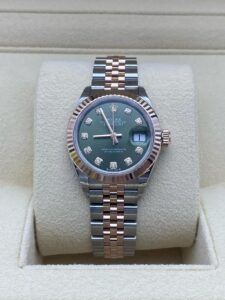
The measurements were not independently verified, and the watches were not evaluated under a standardized testing procedure.
Nevertheless, the discussion highlights a change in how replica Rolex watches are being evaluated.
For years, enthusiasts concentrated on visible differences: case proportions, dial printing, bezel finishing, and bracelet construction.
Now, with heavyweight versions becoming more common, manufacturers are also attempting to reproduce something that cannot be judged from a photograph.
The physical sensation of wearing a solid-gold Rolex.
That raises a question with an unexpectedly complicated answer.
If a replica weighs almost exactly as much as the genuine watch, does that make it a more accurate reproduction?
The Problem With Copying a Gold Watch
The Rolex Day-Date is unusual within the brand’s collection because it is manufactured exclusively in precious metals.
Unlike the Datejust, Submariner, or GMT-Master II, the Day-Date has never been offered by Rolex as a conventional stainless-steel model.
That material choice is fundamental to the watch’s identity.
The modern Day-Date 40 reference 228238 uses an 18-karat yellow-gold case and President bracelet.
Reference 228235 uses 18-karat Everose gold, while reference 228239 is manufactured in 18-karat white gold.
All three references have 40mm cases and use Rolex’s Caliber 3255.
The genuine Day-Date 40 also features the distinctive President bracelet, with its semicircular three-piece links and concealed Crownclasp.
The bracelet contributes substantially to the watch’s appearance, comfort, and overall mass.
Reproducing the design in stainless steel creates an immediate material difference.
Stainless steel is considerably less dense than gold alloys commonly used in luxury jewelry.
A steel watch built to approximately the same external dimensions as a gold Day-Date will generally feel lighter.
That difference is especially noticeable in a watch with a substantial metal bracelet.
Replica manufacturers have responded by introducing heavier versions, often described as tungsten or tungsten-alloy models.
The objective is straightforward: increase the watch’s mass without using a solid-gold case and bracelet.
But the underlying materials science is more complicated than the marketing suggests.
Why Tungsten Became the Answer
Pure tungsten has a density of approximately 19.25 grams per cubic centimeter.
Pure gold has a density of approximately 19.32 grams per cubic centimeter.
Those values are remarkably close.
The comparison explains why tungsten is attractive for applications where substantial mass must fit into a relatively small volume.
However, there is an important qualification.
Rolex does not manufacture its Day-Date cases and bracelets from pure 24-karat gold. It uses 18-karat gold alloys.
An 18-karat alloy contains 75% gold by mass, with other metals making up the remaining 25%.
Those additional metals affect the alloy’s color, hardness, and density.
The London Bullion Market Association explains that an 18-karat gold alloy containing equal proportions of silver and copper has a density of approximately 15.4 grams per cubic centimeter.
That figure is an example of a particular alloy composition, not a published density specification for Rolex’s proprietary gold alloys.
Rolex does not provide a single public density value covering every yellow-, white-, and Everose-gold configuration.
Therefore, comparing pure tungsten directly with pure gold can create a misleading impression.
The densities of the pure elements are similar, but a finished Day-Date is made from an engineered gold alloy and contains many components besides its case and bracelet.
Likewise, a weighted replica may use a tungsten-containing alloy rather than pure tungsten.
The exact composition is often not independently documented.
Its density cannot be established from the word tungsten alone.
A watch’s final weight depends on the materials, the amount of each material used, its internal construction, and the number of bracelet links installed.
Matching the total weight does not prove that any of those characteristics match the original.
The 203-Gram Replica
The July 2026 owner who reported a 203-gram RCF Day-Date was enthusiastic about the result.
Other participants had different priorities.
One commenter argued that added weight did little to improve the actual luxury of the watch. Another owner reported enjoying the heavier feel of a VSF model.
The disagreement reflects two different definitions of accuracy.
For one person, the objective is to reproduce the sensation of holding and wearing the original watch.
For another, the more important characteristics are the case proportions, color, bracelet finishing, and mechanical performance.
Neither preference establishes that a heavier replica is objectively superior.
A 203-gram watch may feel more substantial than a 174-gram alternative, but the additional weight does not automatically improve its dial, movement, or finishing.
There is also a measurement problem.
The weight of a bracelet watch changes when links are removed.
Two examples of the same model can differ in mass simply because they have been sized for different wrists.
Comparing a replica with a genuine Day-Date therefore requires more than placing both on separate scales.
The bracelet configurations must be accounted for.
The watches must also be compared in equivalent conditions, including whether additional links are included.
Even then, matching the total weight would demonstrate only one aspect of similarity.
It would not establish identical weight distribution.
A watch with added mass concentrated in its case may feel different from one whose weight is distributed through a solid-gold bracelet.
Two watches can weigh the same and balance differently on the wrist.
That distinction receives far less attention than the number displayed on a scale.
The Tradeoff Nobody Can See in a Weight Specification
A January 2025 discussion about rose-gold Day-Date replicas introduced another complication.
An owner comparing tungsten and non-tungsten versions argued that the lighter ARF watch had a more convincing rose-gold color.
The heavier alternative offered a more substantial feel but appeared darker and less similar to the genuine Everose-gold finish.
The contributor described the decision as a tradeoff between weight and color.
This was an individual visual comparison, not a controlled color-measurement study.
Still, it identifies a genuine engineering challenge.
The color of a gold watch comes from its material composition and surface characteristics.
Rolex’s Everose gold is a proprietary 18-karat alloy designed to produce a particular warm pink tone.
A replica made from a different underlying material must attempt to reproduce that appearance through its surface finish.
Depending on the product, manufacturers may use electroplating, physical vapor deposition, or other coatings.
Those processes are not interchangeable.
Electroplating deposits material through an electrochemical process. PVD is a family of vacuum-deposition techniques used to produce thin surface coatings.
The durability and appearance of a finished coating depend on its composition, thickness, preparation, adhesion, and exposure conditions.
A manufacturer may increase the mass of the underlying components without achieving a closer match to the genuine gold color.
In some circumstances, improving one characteristic can complicate another.
That does not mean tungsten inherently causes inaccurate gold coloring.
It means the material beneath the surface and the finishing process must be evaluated separately.
A heavyweight specification alone says very little about the visible quality of the final watch.
What Happens After the Gold Finish Starts Wearing?
The most useful evidence about gold-colored replica watches often appears long after the initial purchase.
In May 2026, an owner reported that the gold finish on a weighted Day-Date bracelet had deteriorated after exposure to a swimming pool containing both salt and chlorine.
The watch had reportedly been marketed as gold-wrapped.
According to the owner, the finish on parts of the bracelet changed noticeably after swimming. The post also described apparent cracking or deterioration around the inner lugs.
The owner could not determine whether the salt, chlorine, coating construction, or another factor was responsible.
That uncertainty is important.
A single incident cannot establish that every weighted Day-Date will suffer the same damage.
But it demonstrates why the durability of a surface finish cannot be inferred from the watch’s weight.
A heavier case may feel convincing when new while its external coating remains vulnerable to wear or chemical exposure.
Another owner reported peeling around the lugs and end links of a rose-gold tungsten Day-Date.
The affected watch was described as a THBF V3 model.
The owner wanted to know whether the damaged finish could be repaired or whether the problem would return after replating.
Again, the discussion did not provide a laboratory analysis of the coating failure.
It did show that the practical consequences of surface deterioration can be more complicated than ordinary cosmetic wear.
Replating a finished watch may require disassembly, surface preparation, and compatibility with the underlying material.
Some independent specialists are reluctant to work on particular weighted components or existing coatings.
The result is a product that may be heavy enough to resemble gold but still depend on a comparatively thin external finish for its appearance.
That is a different material construction from a solid-gold Rolex.
Not Every Gold Replica Fails Quickly
There is also evidence that challenges the assumption that gold-colored replicas inevitably deteriorate within months.
In October 2025, an owner published a two-year review of a BP Factory Day-Date 36.
The watch had been worn approximately three or four times per week, according to the account.
Despite regular use, the owner reported that its gold-colored finish remained in satisfactory condition.
The movement was also described as maintaining acceptable timekeeping performance.
This account involved a different watch from the weighted Day-Date examples discussed above.
It cannot establish the durability of tungsten versions or other manufacturers’ coatings.
Nevertheless, it provides an important counterexample.
The statement that every gold-colored replica will quickly lose its finish is not supported by the available evidence.
Some owners report early deterioration.
Others describe years of satisfactory appearance.
The differences may involve manufacturing methods, coating quality, usage conditions, maintenance, and individual expectations.
Without controlled testing across representative samples, there is no reliable basis for assigning a universal lifespan to replica gold finishes.
The most defensible conclusion is that coating durability varies and is not determined by weight alone.
Why Weight Is a Poor Test of Authenticity
The rise of heavyweight replicas also has implications beyond consumer preference.
Traditionally, the substantial feel of a gold watch has been one clue used during informal authenticity assessments.
That clue has limitations.
A genuine gold watch is heavy because of its material construction.
A replica can be made heavy through entirely different materials.
As weighted replicas become more common, the sensation of mass becomes less informative.
The same principle applies to density.
Because tungsten and gold have similar elemental densities, a simple density measurement cannot always distinguish one material from the other.
Professional precious-metal testing may require several complementary methods, depending on the object’s construction.
A watch introduces additional complexity because it contains different metals, a movement, crystal, gaskets, and potentially hollow spaces.
The overall density of the assembled object does not equal the density of its case material.
A 200-gram watch is not proof of solid gold.
Nor does a lighter watch automatically indicate counterfeit construction, particularly when bracelet sizing and model differences are unknown.
Authenticating a Rolex requires more comprehensive evidence than weight.
The relevant questions concern the watch’s identity, components, materials, construction, and provenance.
For the Day-Date, the genuine reference number provides a starting point.
Reference 228238 identifies an 18-karat yellow-gold configuration.
Reference 228235 identifies Everose gold.
Reference 228239 identifies white gold.
Those material specifications belong to the genuine Rolex watches.
A replica carrying the same reference number or resembling the corresponding model does not inherit those specifications.
The Real Meaning of a Heavyweight Replica Rolex
The appeal of tungsten-weighted replicas is understandable. 
A solid-gold Day-Date has a physical presence that is difficult to reproduce with ordinary stainless steel.
Adding mass can make an imitation feel closer to the watch it copies.
For enthusiasts who care about that sensation, the improvement may be meaningful.
But weight is only one property of a finished watch.
The July 2026 comparison showed how substantially different weighted replicas can be, even when they imitate the same Day-Date design.
The January 2025 discussion showed that greater weight may not coincide with more convincing color.
The coating-deterioration reports demonstrated that a substantial feel does not guarantee a durable finish.
And the two-year BP Factory review showed why individual failures should not be generalized into universal claims.
Together, these accounts support a narrower, more useful understanding of heavyweight replica Rolex watches.
Tungsten weighting can improve the sensation of mass. It does not establish equivalence in material, appearance, durability, or manufacturing quality.
That distinction is particularly important for the Day-Date because its genuine identity is inseparable from precious-metal construction.
A replica can reproduce the case shape, bracelet design, dial arrangement, and even much of the original watch’s weight.
Yet the physical reason for that weight may be entirely different.
The result is an interesting achievement in imitation, but it should not be mistaken for a reproduction of Rolex’s gold metallurgy.